
Idaho access control installers and the limited energy license
Idaho's rules list key card operators as limited energy systems, so card access wiring outside 1 and 2 family homes needs a limited energy license.
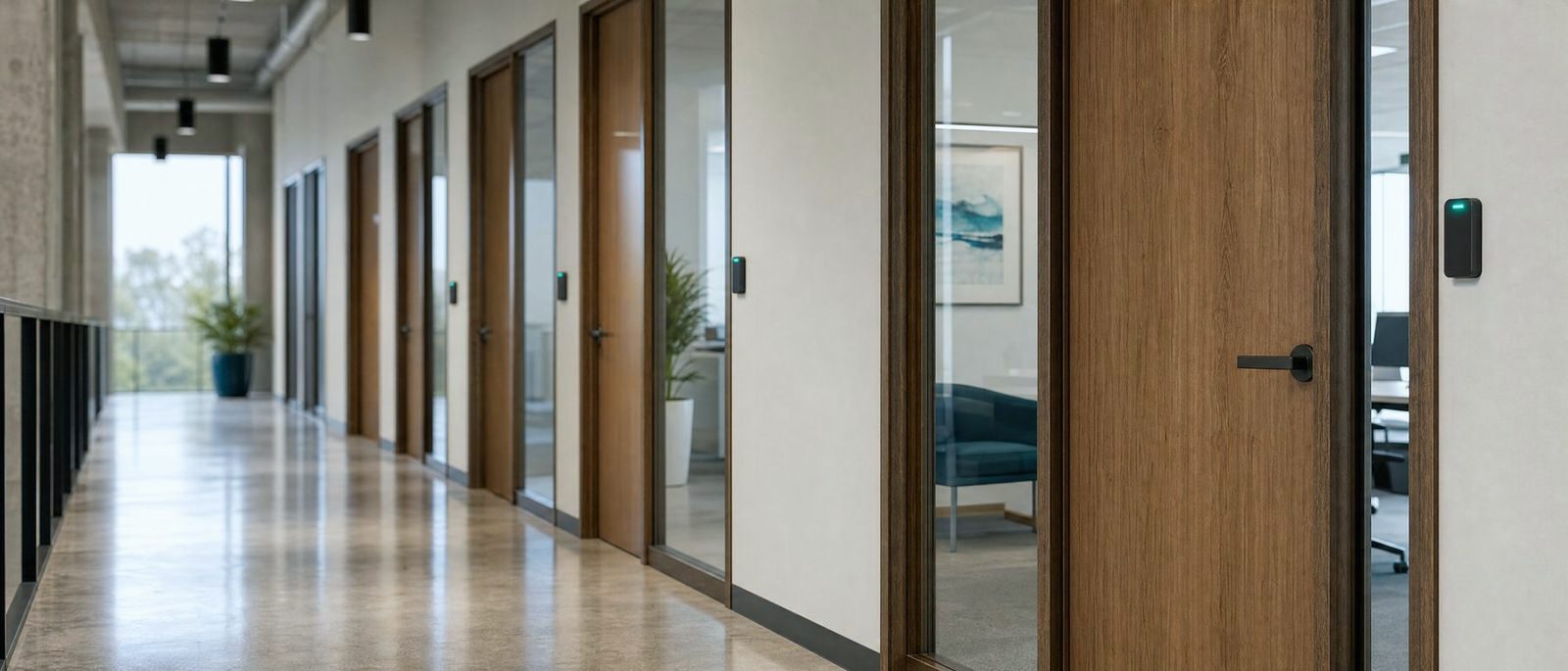
- The license for this job
- Issued by the DOPL Electrical Board: a limited energy limited electrical license
- The experience an installer brings
- A total of 4,000 hours worked in the limited category
- Insurance carried by the contractor
- $300,000 liability
- The codes that apply
- The 2018 IBC and the 2023 NEC, both with amendments
Check an installer's license
Idaho Electrical Board, Division of Occupational and Professional Licenses (DOPL) keeps these records. Search by name or license number.
Open the Idaho lookupGet a price for your doors
Idaho's rules name key card systems
What counts as a limited energy system is set out in IDAPA 24.39.10, the Idaho Electrical Board's rules. It includes nurse call, key card operators, fire and security alarms, and class 2 and class 3 signaling circuits. The low-power wiring that connects readers, keypads and door releases is what makes up signaling circuits.
A limited energy limited electrical license is required for anyone who puts in or fixes wiring for such systems. Buildings that aren't 1 or 2 family homes are covered by the requirement. Its scope includes offices, shops, churches, schools and apartment blocks.
Work outside the rule
Communication wiring gets its own carve-out in the same rule. Telephone systems, public address and intercom systems and data communication systems need no license at all, it states. So a basic intercom that doesn't control a lock may not require an electrical license.
Adding a door release or key card reader brings the job back under limited energy rules. Have your installer tell you, in writing, which side of that boundary your job lands on.
Roles: contractor, installer and trainee
In Idaho, the business and the person doing the work are licensed separately. A limited electrical contractor, under Idaho Code § 54-1003A, can operate only inside the category it's licensed for. Before a license is issued, proof of $300,000 in liability insurance is required, plus worker's compensation where it applies.
A supervising electrician is named by the company to take responsibility for its jobs. For a limited electrical installer, 4,000 hours of experience in that same category are needed. Constant on-the-job supervision is the only way a trainee can work.
- The fee for a limited contractor is $125; the license lasts 1 year.
- You'll pay a $55 fee for a limited installer license, which is valid for 3 years.
- An exam set by the board must be passed by contractor applicants.
Permits, codes and checking a license
Both the 2018 International Building Code and the 2023 National Electrical Code appear on Idaho's adopted codes list, and each includes amendments. Maglocks and powered latches are governed by the egress rules in those adopted codes.
You can find electrical permits and a license lookup on the Electrical Board page. Verify the limited contractor license for the business and the individual installer's license before you let work start.
Price per door, installed
By what's on the door today, here are the published U.S. ranges. After seeing your doors, an Idaho installer will give you a confirmed price.
| On the doors now | Installed, per door |
|---|---|
| Keys only | $1,200 to $2,500 |
| Keypads | $500 to $1,500 |
| Card or fob readers | $500 to $1,500 |
| Not sure | $1,000 to $3,000 |
Compare licenses in every state
Access control installers in a different state
- Alabama
- Alaska
- Arizona
- Arkansas
- California
- Colorado
- Connecticut
- Delaware
- District of Columbia
- Florida
- Georgia
- Hawaii
- Illinois
- Indiana
- Iowa
- Kansas
- Kentucky
- Louisiana
- Maine
- Maryland
- Massachusetts
- Michigan
- Minnesota
- Mississippi
- Missouri
- Montana
- Nebraska
- Nevada
- New Hampshire
- New Jersey
- New Mexico
- New York
- North Carolina
- North Dakota
- Ohio
- Oklahoma
- Oregon
- Pennsylvania
- Rhode Island
- South Carolina
- South Dakota
- Tennessee
- Texas
- Utah
- Vermont
- Virginia
- Washington
- West Virginia
- Wisconsin
- Wyoming