
Commercial access control systems, explained part by part
A commercial access control system decides who can open which door and when. It is made of credentials, readers, door locks, a controller and software, and each choice changes the price and how easy it is to run.
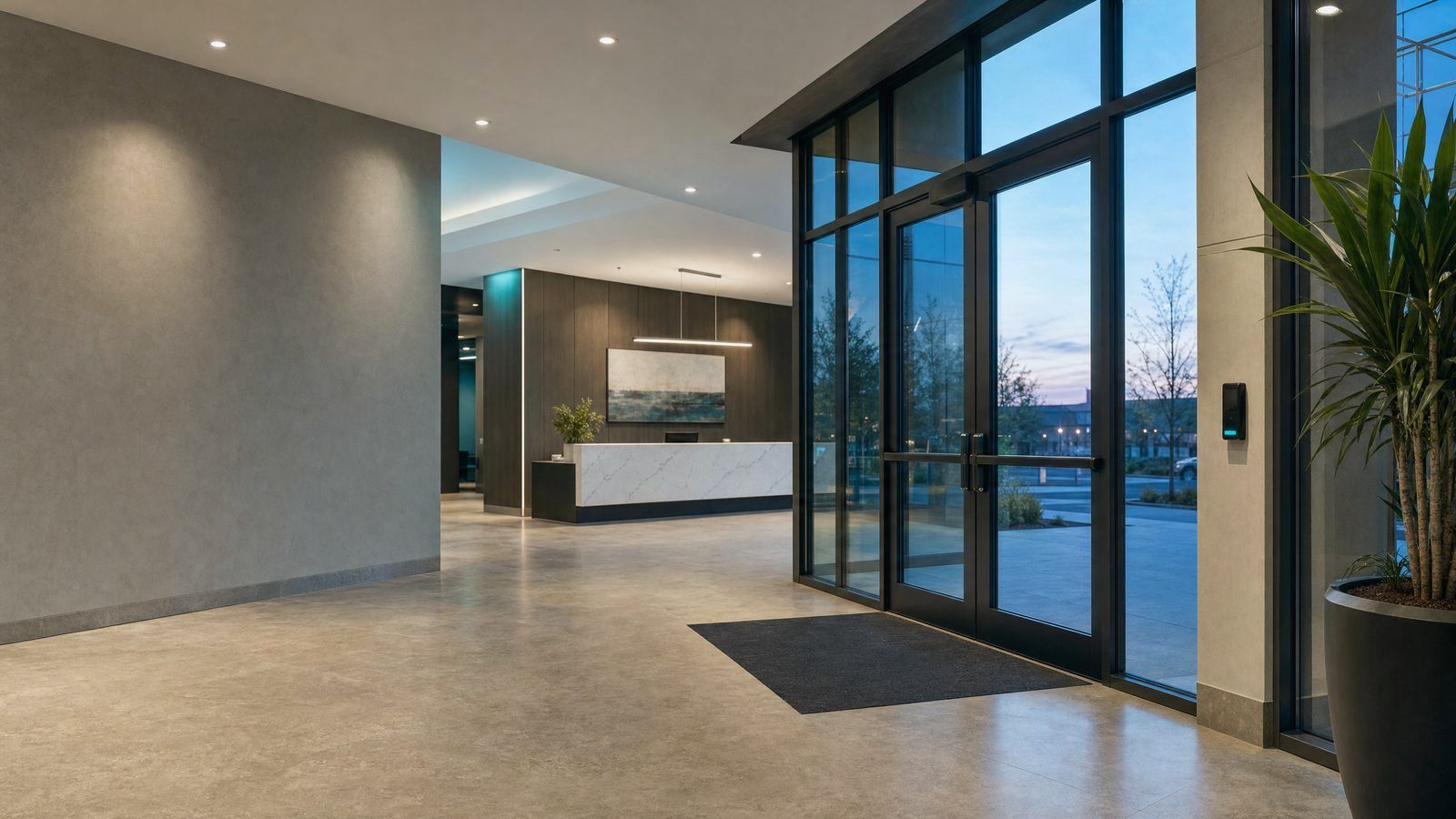
Commercial access control systems control which doors each person can open, using a small set of components that cooperate. Once you understand each component, a quote from an installer stops looking so confusing. Our free door survey takes your answers to three quick questions about your doors and turns them into a short written summary that an installer near you can price, so call now to get yours started.
Installed cost, per door:
- Doors that only have keys: $1,200 to $2,500
- Doors where keypads or card readers already work: $500 to $1,500
- If you don't know what's on your doors: $1,000 to $3,000
What makes up a door access control system
One federal guide describes physical access control as a kind of technology that manages entry by electronically verifying employees, contractors and visitors. The spot where someone encounters it, like a locking door, gate or turnstile, goes by the name access point.
Nearly every setup relies on four core pieces: a reader, a controller, an electronic lock, plus the wiring or connectivity linking them. The reader takes in the credential, meaning the card, fob or code someone shows. The controller matches that data to its records and signals the lock to release or hold. Software, hosted on a server or in the cloud, registers people and records each event.
Two minor add-ons count as well. A door contact reports whether a door stands open or shut. A request-to-exit device releases a locked door from the inside with no credential required.
Card reader door lock system
Each door gets a reader mounted beside it, which scans credentials and either approves or refuses entry. The lock engages or lets go based on electrical current sent by the control panel.
Cards vary a lot in security. Prox cards operate at 125 kHz and transmit without encryption, and ICT says one can be duplicated in 15 seconds or less. Smart cards use the 13.56 MHz frequency, and ICT suggests going with MIFARE DESFire rather than prox.
| Credential type | Cost per card | Copying risk |
|---|---|---|
| 125 kHz prox card or fob | $3 to $8 | Simple and cheap to copy |
| Encrypted 13.56 MHz DESFire or Seos card | $6 to $15 | Much harder to copy |
A Florida installer supplies those figures. With older prox readers in place, HID offers Seos cards that work with both, letting you switch bit by bit.
Picking a lock for commercial door access control
The lock type decides what a power outage means. A fail safe lock unlocks once power goes away. A fail secure lock remains locked with no power. This applies to the outside of the door only, and most products still let people exit freely from inside regardless.
Electromagnetic locks are generally fail safe and call for a release device like a request-to-exit switch. On fire-rated doors, electric strikes have to be fail secure under NFPA 80, per NIH guidance. Let us know which doors are fire-rated and your brief will pass that along to the installer.
Access control system types
Wired systems fit buildings that have a workable cable route and a preference for permanent infrastructure. Wireless fits occupied buildings where running cable would disrupt too much, although wireless locks run on batteries, and replacing them costs $200 to $500 a year.
Cloud-managed systems are usually picked for managing things remotely, and their controllers store credentials on site, so doors keep working if the internet drops. On-premise systems fit organizations that prefer keeping software and equipment under local control.
Across a five-year span, one installer estimates cloud-managed setups at $2,000 to $3,500 for each door, with on-premise setups at $8,000 to $12,000.
What does installation cost for your doors?
Doors lacking an electric lock take the most labor: a lock or strike, a reader, and fresh cable run to a controller. Where electric locks already function, the work is mostly fitting new readers, a controller and configuration. With aging card readers, an interface board can frequently connect them to a new controller.
Expect $4,800 to $10,000 for four doors with keys only. Four doors whose electric locks already work run $2,000 to $6,000. If you are unsure about ten doors, figure on $10,000 to $30,000. Give us a call today and we'll send your brief along to an installer near you who can price the job from it.
Questions we hear often
What does a door contact do in access control?
It's a small sensor fitted to the door and its frame. It tells the system if the door is open or shut, so the system can flag a door held open.
Are government buildings held to different rules?
US federal agencies have to purchase components that satisfy FIPS 201 and sit on the GSA Approved Products List, meaning they cleared security and compatibility testing. The highest-security areas require all three factors: a card, a PIN and a biometric.
Do you handle the installation yourselves?
No. We hand your brief over to an installer in your area, and we are not any vendor named on this page.