
Maglock installation and the rules for letting people out
A maglock is an electromagnet at the top of the door that holds it shut while it has power. Because it locks against people leaving, building codes set strict rules for how it releases, gathered on one printable sheet.
- Key code: IBC 2021 Section 1010.2.12 (the 2024 IBC moves it to Section 1010.2.11)
- Exit button: mounted 40 to 48 inches up, no farther than 5 feet from the door
- Door stays unlocked after a push: 30 seconds minimum
- Installed price: about $500 to $3,000 per door, depending on what's on your doors today
Maglock installation with the usual sensor release is allowed on exit doors in any occupancy except Group H under the 2021 IBC, as long as the lock releases in the ways the code requires. Building codes call the route out of a building egress. Because a magnetic lock grips a door with real force, the code sets rules for sensors, buttons, signs and power.
Start the free door survey to see an estimated price range per door and for the whole building. The three questions ask what is on your doors now, your building type and your door count. Your local installer's quote then starts from what is really on your doors.
What is involved in installing a magnetic lock?
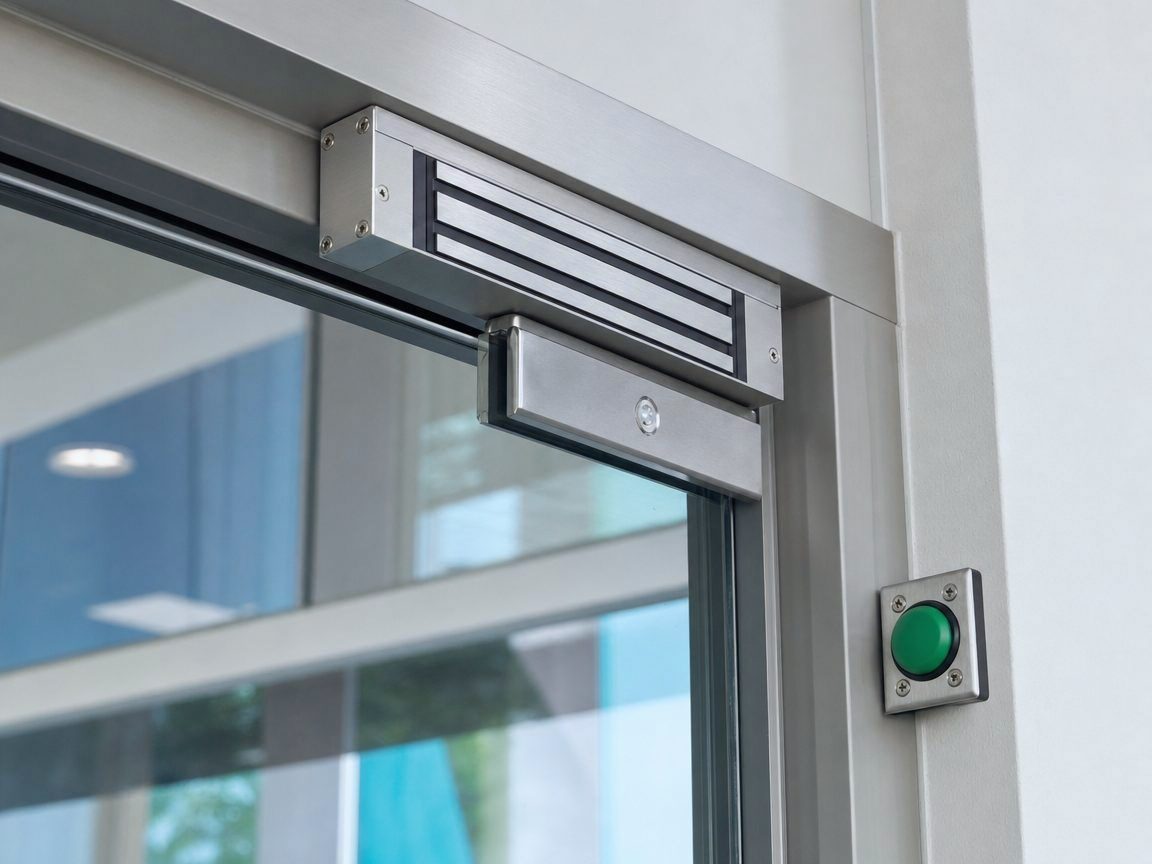
A maglock is a flat magnet mounted on the door frame, paired with a steel plate on the door itself. The door stays locked only while the magnet is powered. NFPA describes the standard arrangement: entry happens with a card, a sensor opens the way out, and a push button acts as the fallback.
So a single door actually involves a group of parts working as one. There is the lock, a power supply for it, a card or fob reader on the outside, a sensor on the inside and a button next to the door. Every one of those parts runs a cable to a power supply or controller.
A maglock's strength is known as its holding force. That is the amount of pull, measured in pounds, the lock can stand before the door gives way. Stronger locks fit exterior doors, while lighter models work well indoors.
| Lock | Holding strength | Typical placement |
|---|---|---|
| Securitron M32 | 600 pounds | Inside doors |
| SDC 1500 series | 650, 1,200 and 1,650 pounds | Three strength options |
| Securitron M62 | 1,200 pounds | Outside and perimeter doors |
It helps, before an installer comes, to write down the closest power outlet and network point for each door. Also look at whether a door is fire-rated. You can tell from a label on the door edge or the frame.
Egress and door hardware code for maglocks and electric locks
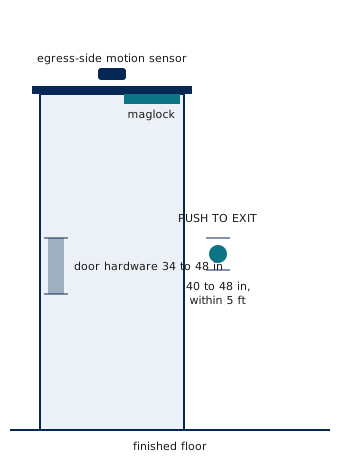
- Sensor release: where allowed
- The 2021 IBC (Section 1010.2.12) allows sensor release of electric locks, the usual maglock setup, on egress doors in any occupancy except Group H. (IBC 1010.2.12, 2021)
- Sensor release: motion sensor
- Under IBC 2021 Section 1010.2.12 a sensor must be installed on the egress side to detect a person approaching the door and unlock it. (IBC 1010.2.12 item 1, 2021)
- Release on loss of power
- Under IBC 2021 Section 1010.2.12 loss of power to the lock or locking system must automatically unlock the electric locks (fail-safe). (IBC 1010.2.12 item 3, 2021)
- Manual release button height and distance
- IBC 2021 Section 1010.2.12 requires a manual unlocking device 40 to 48 inches above the floor and within 5 feet of the secured doors. (IBC 1010.2.12 item 4, 2021)
- PUSH TO EXIT sign
- IBC 2021 Section 1010.2.12 requires the manual unlocking device to be clearly identified by a sign that reads PUSH TO EXIT. (IBC 1010.2.12 item 4, 2021)
- Button cuts power, stays unlocked 30 seconds
- Under IBC 2021 Section 1010.2.12 the PUSH TO EXIT device must directly cut power to the lock, and the lock must stay unlocked at least 30 seconds. (IBC 1010.2.12 item 4, 2021)
- Release on fire alarm
- Under IBC 2021 Section 1010.2.12, where a fire alarm system is provided, its activation must unlock the electric lock until the alarm is reset. (IBC 1010.2.12 item 5, 2021)
- Release on sprinkler or fire detection
- Under IBC 2021 Section 1010.2.12, activation of the sprinkler or fire detection system, where provided, must also unlock the electric lock. (IBC 1010.2.12 item 6, 2021)
- Emergency lighting and UL 294
- IBC 2021 Section 1010.2.12 also requires emergency lighting on the egress side and locking units listed to UL 294. (IBC 1010.2.12 items 7 and 8, 2021)
- Door hardware release
- IBC 2021 Section 1010.2.11 allows door hardware release, where operating the hardware on the door leaf directly cuts power to the lock and unlocks it immediately. (IBC 1010.2.11, 2021)
- Door hardware release: one hand
- Under IBC 2021 Section 1010.2.11 the releasing door hardware must be operable with one hand. (IBC 1010.2.11 item 2, 2021)
- Door hardware release: panic hardware
- Under IBC 2021 Section 1010.2.11, where panic hardware is required, pushing the panic bar must also release the electric lock. (IBC 1010.2.11 item 5, 2021)
- Sensor release numbering in 2024 IBC
- In the 2024 IBC the sensor release section is numbered 1010.2.11 (it was 1010.2.12 in 2021) and keeps the 40 to 48 inch manual unlocking device. (IBC 1010.2.11, 2024)
- Door hardware release numbering in 2024 IBC
- In the 2024 IBC the door hardware release section is numbered 1010.2.10 (it was 1010.2.11 in 2021). (IBC 1010.2.10, 2024)
- UL 294 or UL 1034 listing (2024)
- The 2024 IBC sensor release section requires the electromechanical or electromagnetic locking device to be listed to UL 294 or UL 1034. (IBC 1010.2.11 item 8, 2024)
- Delayed egress time
- IBC 2021 Section 1010.2.13.1 lets delayed egress locks hold the door no more than 15 seconds (30 seconds where approved) after a push of up to 3 seconds. (IBC 1010.2.13.1 item 4, 2021)
- Delayed egress: sprinklered buildings only
- IBC 2021 Section 1010.2.13 allows delayed egress locks only in buildings with full sprinklers or an approved automatic smoke or heat detection system. (IBC 1010.2.13, 2021)
- Delayed egress sign
- IBC 2021 requires a delayed egress door sign reading PUSH UNTIL ALARM SOUNDS. DOOR CAN BE OPENED IN 15 [30] SECONDS, within 12 inches above the exit hardware. (IBC 1010.2.13.1 item 6, 2021)
- Hardware height
- IBC 2021 Section 1010.2.3 requires door handles, locks and other operating devices to be 34 to 48 inches above the finished floor. (IBC 1010.2.3, 2021)
- Sensor-release manual release height
- NFPA 101 (2021) Section 7.2.1.6.2, sensor-release of electrical locking systems (formerly access-controlled egress door assemblies), puts the manual release 40 to 48 inches high within 60 inches of the door. (NFPA 101 7.2.1.6.2.1(3)(a), 2021)
- Sensor-release manual release 30 seconds
- NFPA 101 (2021) requires the PUSH TO EXIT manual release to directly interrupt lock power and keep the lock unlocked at least 30 seconds. (NFPA 101 7.2.1.6.2.1(3)(d), 2021)
- Sensor-release unlock on power loss
- NFPA 101 (2021) requires sensor-release doors to unlock automatically on loss of power to the sensor or the locking part of the system. (NFPA 101 7.2.1.6.2.1(2), 2021)
- Delayed egress time
- NFPA 101 Section 7.2.1.6.1 (as quoted by an electrical CE course page) releases a delayed-egress lock within 15 seconds, or 30 seconds where the authority approves. (NFPA 101 7.2.1.6.1.1(3), quoted text, edition not stated)
- Operable parts reach range
- The 2010 ADA Standards (308.2.1) set the unobstructed forward reach range at 15 inches minimum to 48 inches maximum above the floor. (ADA 2010 Standards 308.2.1, 2010)
- Operation without grasping or twisting
- ADA 2010 Section 309.4 requires operable parts to work with one hand, without tight grasping, pinching or twisting, at 5 pounds of force maximum. (ADA 2010 Standards 309.4, 2010)
- Door hardware height
- ADA 2010 Section 404.2.7 places operable door hardware 34 to 48 inches above the finish floor. (ADA 2010 Standards 404.2.7, 2010)
- Door closing speed
- ADA 2010 Section 404.2.8.1 requires closers to take at least 5 seconds to move the door from 90 degrees open to 12 degrees from the latch. (ADA 2010 Standards 404.2.8.1, 2010)
- Door opening force
- ADA 2010 Section 404.2.9 limits the push or pull to open an interior hinged door to 5 pounds maximum (fire doors excepted). (ADA 2010 Standards 404.2.9, 2010)
- PUSH TO EXIT sign lettering (local example)
- The IBC sets no letter size for the PUSH TO EXIT sign; as a local example, Deer Park, Texas requires white letters at least 1 inch high, 1/8 inch stroke, on red. (Deer Park, TX Fire Marshal policy Special Lock Systems policy item 6, local policy, current)
- Push button size (local example)
- Deer Park, Texas also requires push to exit buttons at least 2 inches in diameter that do not have to be held in to unlatch. (Deer Park, TX Fire Marshal policy Special Lock Systems policy item 6, local policy, current)
Downloads: door heights diagram (SVG). Printing this page gives a one-page sheet.
Sources: codes.iccsafe.org, idighardware.com, electricallicenserenewal.com, access-board.gov, deerparktx.gov
Rules for letting people out
IBC 2021 Section 1010.2.12 says a sensor on the inside has to detect someone approaching the door and release the lock. This arrangement is permitted in every building occupancy apart from Group H, which is for buildings holding high-hazard materials.
A manual button must be there as well, as a backup. It has to be mounted 40 to 48 inches off the floor and no more than 5 feet from the door. A sign saying PUSH TO EXIT must identify it. After someone pushes it, the door has to remain unlocked for a minimum of 30 seconds.
The same section also requires two more things. The inside of the door needs emergency lighting, and the locking hardware has to carry a UL 294 listing. UL 294 is the safety standard covering access control equipment.
The code also offers another route, known as door hardware release, under Section 1010.2.11. With this method, turning the handle or pressing the bar on the door kills power to the lock at once. That hardware has to be usable with one hand. If a panic bar is required, pressing it has to release the maglock as well.
Anything people operate, like handles and locks, must be positioned 34 to 48 inches above the floor. That lines up with the 2010 ADA Standards, which also call for one-handed operation without tight grasping, pinching or twisting.
Which code applies to your building?
Most towns in the US follow some edition of the International Building Code. Plenty of them also use NFPA 101, the Life Safety Code. The two codes agree on the essentials, though the section numbers shift from edition to edition.
| Requirement | IBC 2021 | IBC 2024 |
|---|---|---|
| Release by sensor | Section 1010.2.12 | 1010.2.11 |
| Release at the door hardware | Section 1010.2.11 | 1010.2.10 |
| Listing for the lock | UL 294 | UL 294 or UL 1034 |
In the 2024 IBC, the button height stays at 40 to 48 inches. NFPA 101 (2021) sets the button at that same height and within 60 inches of the door, and it keeps the 30 second unlock period too.
Your town may layer extra rules on top. Deer Park, Texas, for instance, demands a building permit for each electromagnetic lock that uses electronics on the way out. It also wants exit buttons no smaller than 2 inches across that stay released without being held. The PUSH TO EXIT sign there must show white letters at least 1 inch tall on a red background.
Some buildings want the door to hold for a short time before it opens. This is called delayed egress. The IBC permits it only where the building has sprinklers throughout or an approved smoke or heat detection setup. A delayed egress lock may hold the door for no more than 15 seconds after a push of up to 3 seconds, or 30 seconds where the local authority approves. A sign no more than 12 inches above the hardware explains this to people.
Wiring and power for a maglock
Code says a maglock must be fail-safe. In practice, the lock opens on its own any time power is lost, so nobody can be trapped inside by a power cut. Securitron includes an instant release circuit that leaves behind no residual magnetism gripping the door.
The PUSH TO EXIT button has to interrupt power to the lock directly. If the building has a fire alarm, triggering it must unlock the door until someone resets the alarm. If sprinklers or a fire detection system are present, their activation must unlock the door too.
A maglock typically requires a dedicated power supply added for it, unlike most electric strikes. Correct wiring is what keeps the door safe, which is why the brief tells the installer exactly what your doors have today.
Maglock installation cost
The figures here are published estimates for a US door. The true price comes only from an installer who has looked at your doors.
| Current door setup | Price installed, per door |
|---|---|
| Just keys | $1,200 to $2,500 |
| Working electric locks or keypads | $500 to $1,500 |
| Card or fob reader | $500 to $1,500 |
| Unsure | $1,000 to $3,000 |
A keys-only door needs the most labor: a lock, a reader, plus new cable running to a controller. With 4 such doors, the total lands between roughly $4,800 and $10,000. Vicom's guide prices a complete card door, with reader, lock, power supply, controller and labor, at about $1,500 to $2,000.
Questions people ask
Is a power supply needed for a maglock?
It is. Since a maglock only holds while current flows, it needs a reliable supply. Vicom puts a power supply with battery backup at roughly $150, in addition to about $300 for the lock.
How much is the hardware by itself?
Kisi reports that basic single-door kits begin near $200 to $500 for hardware only. Cloud-connected kits run $500 to $1,500 or higher for each door, and a software license comes on top. In one industry discussion, installer labor by itself ran from $400 to $1,600 per door.
Is a maglock allowed on a fire-rated door?
The Securitron M62 is listed as fire rated for 3 hours, but that alone does not show it can go on your particular fire-rated door. The installer has to know the door's own rating, which appears on a label on the door edge or frame.
Who answers when I call?
Your call goes to Access Control Installer, not to a manufacturer, vendor or state agency, and it may be recorded.
Want to know what your doors will cost? Answer three quick questions in the door survey, or call and describe them. It's free, and a local installer in your ZIP code will contact you and set the real price once they've seen your doors. Add details to the brief, such as the brand already on site, how people should open the doors, or whether you'd like cameras or an intercom.