
Gate access control system for vehicle and pedestrian gates
A gate access control system decides who can open a vehicle or pedestrian gate: a keypad or reader on a post, a phone app, windshield tags or a plate camera, wired to the operator that moves the gate.
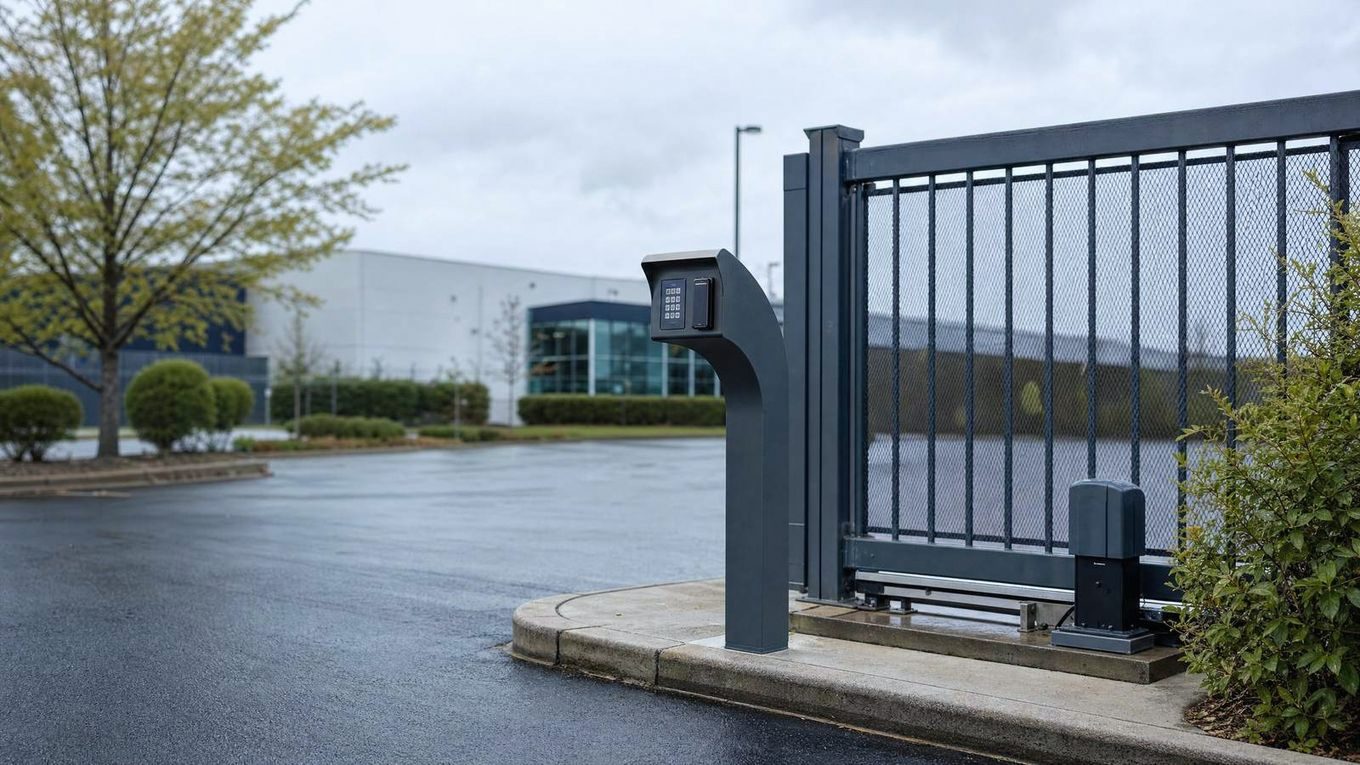
A gate access control system is what decides who gets to open your gate, whether they arrive in a car or on foot, and it works through a keypad, a card, an app, a windshield tag or a callbox. If you have a commercial or HOA entry lane and the gate is already standing, Tech Pro Security puts the typical cost of the complete setup at $10,000 to $25,000.
- Complete entry lane for a commercial site, gate already in place: $10,000 to $25,000 for each lane
- Gate operator built for commercial use: $3,500 to $9,000 for each operator
- Replacing a callbox: $2,500 to $5,000 for each lane
- Stickers that go on the windshield: $3 to $8 apiece
Want a number for your own gate? Call us to describe it, or use the free door survey and add the gate to your brief, and a local installer can price the work after seeing the site.
Ways for drivers to open the gate
A driver has several ways to open a gate, and which one fits depends on the people passing through. Keypads and card readers usually mount on a gooseneck, a curved post set at the driveway's edge. Gate Depot places the device roughly 42 inches off the ground to suit cars.
LiftMaster's keypad systems can connect to the gate operator without wires. Wiring them is also an option when you want more security, so a driver must present both a card and a PIN.
A long-range RFID reader tends to be the simplest pick for people who drive in daily. With RFID, radio waves read a small tag on the vehicle, so windows stay up. LiftMaster's LMSC1000 picks up vehicle tags from 20 to 30 feet away, letting drivers roll through without stopping.
Your gate also has to sense where vehicles are. That job falls to a vehicle loop, a wire embedded in the pavement that detects a car over it. Gate Depot notes that loops can trigger the gate to open for a departing car, or serve as a safety measure that keeps the gate from closing onto a vehicle.
Controlling a parking gate for residents, guests and staff
What works for a resident rarely works for a visitor or a delivery driver. Most parking gates blend 2 or 3 of these options:
- Windshield stickers: scanned without rolling a window down, from 8 to 25 feet away, and they break apart if someone tries to remove them, according to Tech Pro Security
- Credentials on a phone, through Bluetooth or an app: the right fit for visitors, vendors and employees, running $0 to $4 monthly per user
- Phone-based entry that includes guest passes: LiftMaster's myQ Community gives residents phone-based opening of the entrances they may use, plus temporary passes for guests
- License plate cameras: the camera checks the plate and lets approved vehicles through
- Callbox or video intercom: a visitor rings a resident, who opens the gate
Stickers cost $3 to $8 each, and the long-range reader is priced per lane.
Gate access costs per lane
These numbers are drawn from Tech Pro Security's gate access guide and its installation cost guide.
| Item | Usual cost | Priced per |
|---|---|---|
| Lane controller for residents, with long-range RFID reader | $3,500 to $8,000 | Lane |
| Camera that reads license plates, one direction | $2,500 to $6,000 | Lane |
| Replacing a telephone entry callbox | $2,500 to $5,000 | Lane |
| Video intercom that includes a resident directory | $5,000 to $9,000 | Lane |
| Vehicle loop plus detector, cut into the pavement | $400 to $900 | Loop |
| Photo eyes, edge sensors and warning signs | $300 to $1,500 | Lane |
| Gate operator, commercial grade | $3,500 to $9,000 | Operator |
| Gate operator, residential grade | $1,500 to $4,000 | Operator |
| Sticker for the windshield | $3 to $8 | Car |
| Credential on a phone or app | $0 to $4 a month | User |
If you have a rolling gate, R3 Access reports that mid-range commercial openers cost $2,500 to $4,500, and the typical installed total lands between $2,500 and $6,500.
Do special rules apply to a gate entry system at a commercial site?
Yes. UL 325, a US safety standard covering automatic gate openers, applies to commercial gate operators. DASMA defines Class II operators as the kind used at places like apartment buildings with 5 or more units, plus hotels, garages and retail stores.
The most important rule deals with keeping a moving gate from trapping anyone. An entrapment protection device, like a photo eye or a soft edge mounted on the gate, is a sensor that halts or reverses the gate when something blocks its path. LiftMaster states that since August 1, 2018, an operator may only run once at least 2 independent devices are in place for each direction. The reversing system built into the operator counts as 1 of the 2.
Those sensors also need monitoring from the operator. DoorKing explains that the gate refuses to run if it detects a faulty sensor or finds one gone. So a sensor with a fault, or one that is missing, will stop the gate from running, which is one more reason to have an installer match the parts.
A handful of other points from DASMA influence how a commercial entry gets laid out:
- Any button or control that opens the gate must be at least 6 feet away from it, so no one can reach through
- Two or more warning signs must be posted by the gate
- Slide gate operators in Class I and II may not exceed 1 foot per second while moving a load of 75 pounds or more
Why do people on foot need a separate gate?
Gate operators under UL 325 exist for vehicles alone, so DASMA requires property owners to give people on foot a separate entrance. The pedestrian gate can share the same cards, codes or phone app used on the building's doors, which means residents only carry one credential. Getting this wrong leaves walkers beside a moving vehicle gate, so it pays to settle the plan before any work begins.
The gate itself
Before any opener is attached, the gate has to be built to a safe standard. ASTM F2200 is that standard for automated vehicle gates, and it covers swing, slide, bifold, vertical lift, vertical pivot and overhead pivot designs. According to DoorKing, it requires slide gate openings to be screened up to 72 inches high, tight enough that a 2.25 inch ball cannot fit through.
LiftMaster recommends that owners ask their installer to comply with UL 325 as well as ASTM F2200.
Adding your gate to the survey brief
When you fill in the door survey, it asks about the hardware on your doors today, your building type and how many doors you have, then gives you a price range for each door and for the property as a whole. Count your building's doors, not the gate. After that, under Add details to the brief, pick Gate and describe how people should enter: key cards or fobs, phones, PIN codes, or some combination. You may also mention any panel or brand already installed, note who owns the property, and include cameras or an entrance intercom.
Your brief goes to a local access control installer serving your ZIP code, who will contact you about the doors and can discuss the gate details you included. The ranges on this page are estimates taken from public cost guides and vendor price lists, and the installer determines the real price once they have seen the site.
Common questions
What three kinds of access control can a gate use?
Gates rely on 3 main kinds: something you know, like a keypad code, something you carry, like a card, tag or phone, and someone granting you entry through a callbox or video intercom. Plenty of sites run all 3 together, so residents, guests and deliveries each have a way in that suits them.
Can a gate opener be linked to your car?
The standard way to link a car to a gate is a windshield tag or sticker. These stickers are destroyed when removed, so they can't easily be moved to another car.
How can I tell whether a gate operator is safe?
Check the operator for a listing mark. DoorKing advises never installing one unless it carries a listing mark from a nationally recognized testing laboratory, like ETL, MET or UL.
Will my call go to the gate manufacturer?
No. Calls go to Access Control Installer, never to a manufacturer, vendor or state agency.
Does sending the brief cost anything?
Sending a brief costs nothing. Call us or take the three-question door survey and add your gate, so a local installer sees your gate details before the visit and the quote fits what you really have.