
Colorado access control installers: state law, then your city
Colorado's electrical licensing law does not cover security systems of 50 volts or less, so door access licensing falls to cities such as Denver.
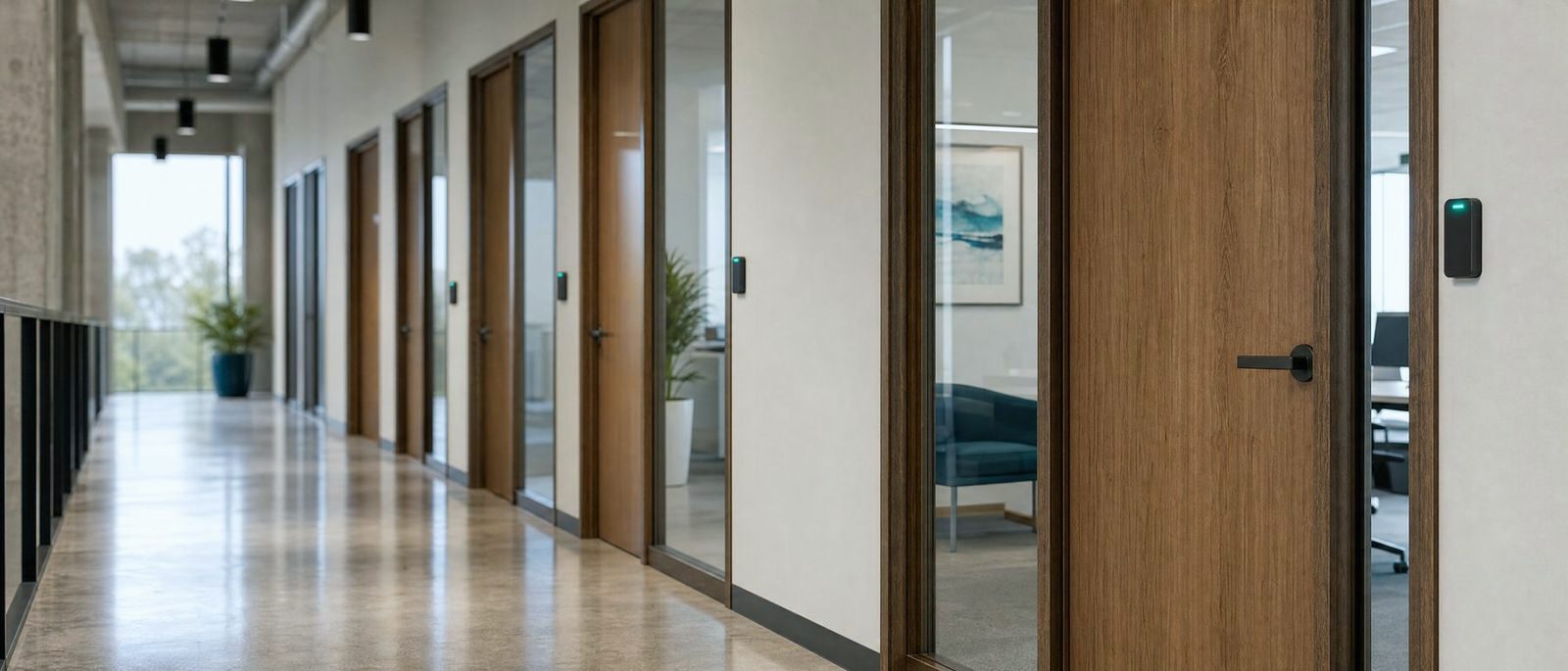
- Licensing for access control at the state level
- No statewide license exists; security systems running at 50 volts or less sit outside the licensing rules.
- Certificate from Denver
- ICC exam #490, Access Control System Supervisor
- Code for electrical work
- Effective August 1, 2023, the 2023 NEC applies
- Readers using biometrics
- Consent rules under HB24-1130 take effect July 1, 2025.
Check an installer's license
City and County of Denver, Community Planning and Development, Contractor Licensing keeps these records. Search by name or license number.
Open the Colorado lookupGet a price for your doors
Exemptions in the state electrical law
The State Electrical Board handles electrician licensing in Colorado. The statute includes many exemptions, spelled out in C.R.S. 12-115-116. Security systems that run at 50 volts or less fall outside the article's scope, according to one exemption. The licensing rules do not reach contractors on those jobs or the people they employ.
One more exemption has a wider reach. As the National Electrical Code defines them, remote-control, signaling, and power-limited circuits in class 2 and class 3 aren't subject to the article. Wiring for readers and locks is mostly power-limited: the power supply restricts the current.
You do not need a license for low-voltage fire alarm work either, but state inspections and permits still apply. No other part of state government issues a license for door access installers.
Denver offers its own access control certificate
When the state does not license the work, cities step in. On Denver's electrical certificates page you will find an Access Control System Supervisor certificate. It applies to control units, electric hardware for doors and wiring that manages entry and exit.
The work must run at 48 volts or below, or use power-limited circuits. You cannot put in a full conduit or raceway system under this certificate.
- You need 3 years in the access control trade, which must include electrical tasks plus hardware like maglocks, card readers, electric locks, and strikes.
- For projects done within the last 10 years, supply notarized letters that state the work, dates, and locations.
- A passing score on ICC Exam #490 Access Control Supervisor.
- Anyone holding a Colorado state electrical license applies for a contractor license instead, with no certificate needed.
Powered doors: codes and permits
The State Electrical Board adopted the 2023 National Electrical Code, which took effect August 1, 2023. Cities and counties have to meet the minimum; they can also enact stricter ones.
A rulemaking hearing to adopt the 2026 code is posted on the State Electrical Board homepage for May 27, 2026. Check with your local building office to see which edition it follows and if a lock change requires a permit.
Privacy laws apply to fingerprint and face readers
Through HB24-1130, Colorado updated its privacy law with biometric provisions that took effect July 1, 2025. Any business gathering biometric identifiers must keep a written policy that spells out how long it stores data and how it handles a breach.
Before gathering any data, it must also satisfy rules about telling people and getting their consent. An employer's reasons for seeking consent from workers are restricted by the law. Work this out before you choose a face or fingerprint reader for a time clock or a door.
Price per door, with installation
Ranges published for the U.S. by current door hardware. A Colorado installer will verify the price once they've looked at your doors.
| On the doors now | Installed, per door |
|---|---|
| Keys only | $1,200 to $2,500 |
| Keypads | $500 to $1,500 |
| Card or fob readers | $500 to $1,500 |
| Not sure | $1,000 to $3,000 |
Compare licenses in every state
Installers for access control in another state
- Alabama
- Alaska
- Arizona
- Arkansas
- California
- Connecticut
- Delaware
- District of Columbia
- Florida
- Georgia
- Hawaii
- Idaho
- Illinois
- Indiana
- Iowa
- Kansas
- Kentucky
- Louisiana
- Maine
- Maryland
- Massachusetts
- Michigan
- Minnesota
- Mississippi
- Missouri
- Montana
- Nebraska
- Nevada
- New Hampshire
- New Jersey
- New Mexico
- New York
- North Carolina
- North Dakota
- Ohio
- Oklahoma
- Oregon
- Pennsylvania
- Rhode Island
- South Carolina
- South Dakota
- Tennessee
- Texas
- Utah
- Vermont
- Virginia
- Washington
- West Virginia
- Wisconsin
- Wyoming